
From Wonder to Wisdom: How Montessori Builds the Imagination That Lasts a Lifetime (Part 2)
PART 2: From the Concrete to the Cosmos — How Early Childhood Materials Ignite the Elementary Imagination
In Part One of this series, we explored Dr. Montessori's profound belief that imagination is nourished not by fantasy alone, but by reality. The richer children's concrete experiences of the world, the more powerfully their imagination can soar. In Part Two, we look at how this actually unfolds: how the carefully designed materials of the early childhood classroom lay the groundwork for the extraordinary imaginative life of the elementary-aged child.
What the Youngest Children Are Really Doing
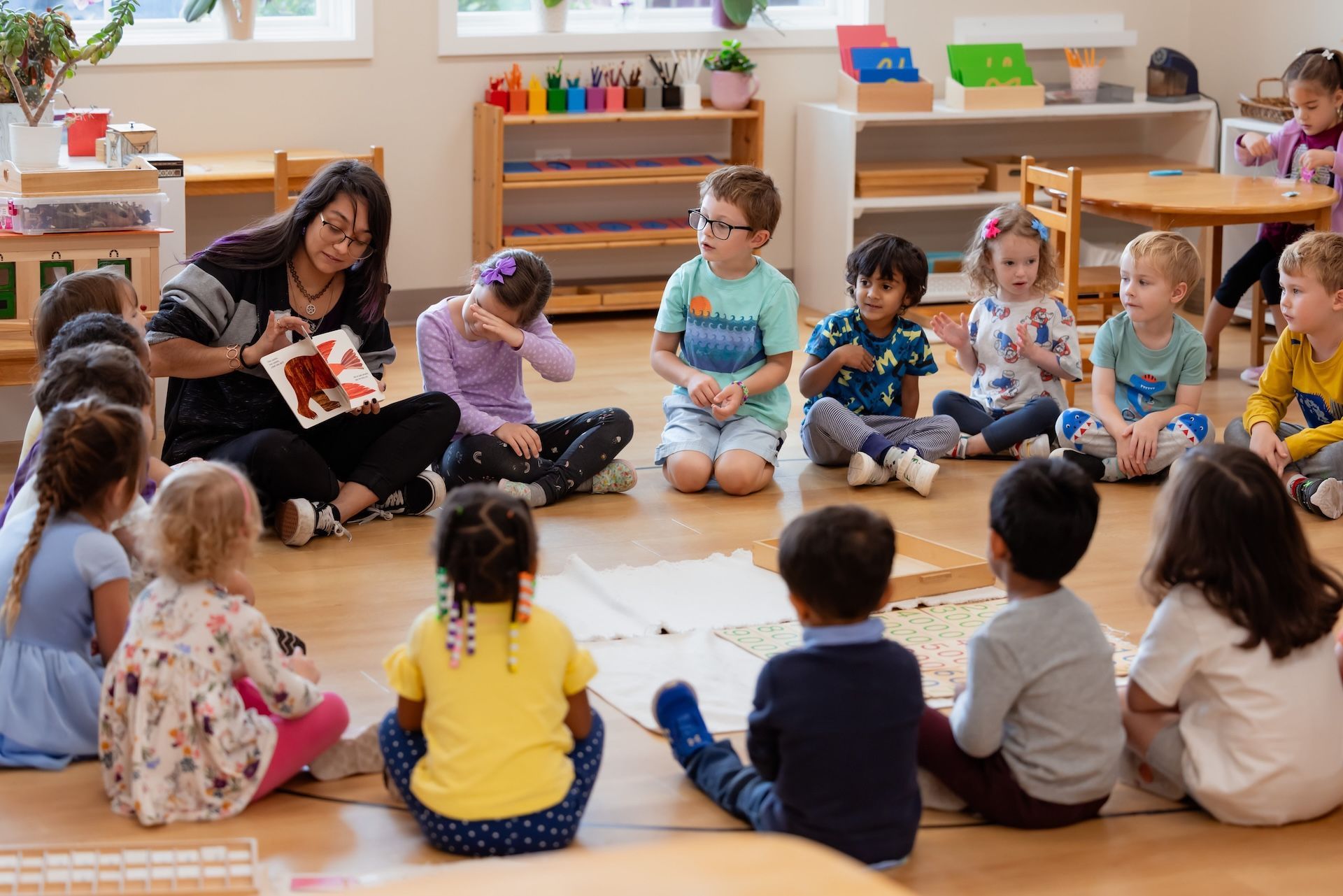
Watch young children in a Montessori classroom, and you might see them tracing the edges of a triangle with their fingertips, testing objects to compare dimensions, fitting puzzle pieces of the continents together, or carefully moving golden beads that represent units, tens, hundreds, and thousands. These activities look deceptively simple. But something of tremendous importance is happening beneath the surface.
These children are building the architecture of their minds.
Dr. Montessori was clear about where all thinking begins: "There is nothing in the intellect which was not first in the senses." Before a child can think abstractly, before they can imagine what they cannot see, they must first have a rich, precise, embodied experience of the world around them. The sensorial materials of the Children's House are designed to provide exactly this. They train children's powers of observation, sharpen children’s ability to notice distinctions, and lay down a concrete mental structure that will serve children for the rest of their lives.
Precision as the Foundation for Possibility
This emphasis on precision might seem at odds with imagination, but in Montessori, it is the very source of it. As Dr. Montessori wrote in
The Advanced Montessori Method, "If the true basis of the imagination is reality, and its perception is related to exactness of observation, it is necessary to prepare children to perceive the things in their environment exactly, to secure for them the material required by the imagination."
In other words, the more accurately a child can see and understand the real world, the richer they can imagine beyond it.
Consider geometry. When a young child explores geometric shapes and solids with their hands, by touching edges, rotating forms, and fitting pieces into matching frames, they are not simply learning shapes. They are building a sensory foundation from which, years later, they might begin to conceptualize the support structure of a bridge, understand the geometry of navigation, or envision architectural forms that don't yet exist. The hands-on work of early childhood quietly becomes the creative capacity of the older child and the adult.
The Bridge Into the Elementary Years
Something significant shifts around age six. Children who spent years absorbing concrete impressions of the world now begin to hunger for something more. They want to understand not just the things in front of them, but the larger story: how those things came to be, how they connect, what lies beyond the visible horizon of their direct experience.
The emergence of the reasoning mind and the explosive growth of the imagination are the hallmarks of the second plane of development. And these superpowers emerge because of everything that came before.
The child who handled the golden bead material in early childhood by counting and carrying hundreds and thousands, now has the concrete foundation to comprehend something almost unfathomable: the immense passage of geological time, from the formation of the universe to the emergence of human civilization, as depicted on the Montessori timelines and clock of eras. The quantities they once held in their hands now help them grasp epochs they can never directly touch. The concrete has become a gateway to the infinite.
As Dr. Montessori described it in
To Educate the Human Potential: "Imaginative vision is quite different from mere perception of an object, for it has no limits. Not only can imagination travel through infinite space, but also through infinite time; we can go backwards through the epochs, and have the vision of the earth as it was, with the creatures that inhabited it."
When Imagination Starts from Reality, It Can Change the World
There is powerful idea running through all of this, one that reaches well beyond education into the nature of human creativity itself. When imagination is untethered from reality, it tends to stay small or drift into what Dr. Montessori called mere speculation. But when imagination is rooted in genuine understanding, something transformative becomes possible.
As she wrote: "When imagination starts from contact with reality, thought begins to construct works by means of which the external world becomes transformed; almost as if the thought of man had assumed a marvelous power: the power to create."
This is the arc that Montessori traces across the first 12 years of a child's life. In early childhood, we give children the real world: carefully, beautifully, precisely. In the elementary years, children take that grounded understanding and begin to reach toward the cosmic, the historical, the abstract, and the creative. One stage makes the next one possible. And the imagination that emerges is not a flight from reality, but its highest expression.
What We Can Take From This
The Montessori environment makes so much sense when we think about this developmental progression! The sensorial materials are not busy work. The real objects are not a rejection of play. The carefully prepared lessons are not limitations on creativity.
Each of these things builds minds that are grounded, precise, and curious enough to one day imagine things the world has never seen before.
Dr. Montessori always believed that the child holds the future within them. The work of the classroom (and of the family) is simply to give that future the richest possible foundation from which to grow.
We'd love to show you how these stages of development connect in our classrooms in New York. Schedule a visit and see the full arc of Montessori learning in action.