
It Wasn't Just Montessori: What the Greatest Child Development Theorists All Observed
When families first encounter Montessori philosophy, they sometimes wonder: Is this just one person's theory? How does it hold up against the broader landscape of what we know about child development?
The answer is both fascinating and reassuring. The core insights at the heart of Montessori education are not unique to Dr. Maria Montessori. Some of the most influential developmental thinkers of the twentieth century (think Erik Erikson, Jean Piaget, and Lev Vygotsky) arrived at remarkably similar conclusions through their own independent research. When we place their work alongside Dr. Montessori's, the convergences are striking.
The Child as a Psychic Embryo
Dr. Montessori recognized that when children are born, they are not yet complete people. They cannot walk or talk, but their brains are ready to receive. In this sense, Dr. Montessori called them psychic embryos: psychic meaning mind, and embryo meaning forming. Their minds are forming. They begin a process similar to that which they experienced prenatally. They begin constructing themselves through the absorbent mind and sensitive periods.
As psychic embryos, children's personalities, minds, and characters are in formation. Their mental organs are developing in response to their experiences in the environment. Their inner teacher guides them, yet need the adults in their lives to support this process.
What is especially significant about this process is how different it is from the way adults acquire knowledge. As Dr. Montessori writes in
The Absorbent Mind:
"The child has a different relation to his environment from ours. Adults admire their environment; they can remember it and think about it; but the child absorbs it. The things he sees are not just remembered; they form part of his soul. He incarnates in himself all in the world about him that his eyes see and his ears hear. In us the same things produce no change, but the child is transformed by them."
This vital kind of memory, with children absorbing images into their very lives, Dr. Montessori connected to the concept of the Mneme, a term coined by Sir Percy Nunn to describe this deep, unconscious memory that shapes who children are becoming.
Erik Erikson: Trust, Autonomy, and Identity
Erik Erikson (1902–1994), a follower of Freud, proposed that individuals move through psychosocial stages from birth through death. Like Montessori, Erikson recognized that development extended well beyond childhood. He focused on how individual identity develops and believed that progression through each stage is shaped by the attitudes and skills that enable people to become active, contributing members of society. In this way, Erikson and Montessori are closely comparable, especially when we consider Montessori's understanding of the individual's cosmic task.
Erikson recognized that in the first year of life, children who receive warm, responsive care develop trust that the world is good, while infants who wait too long for comfort or are handled too harshly develop mistrust of the world. He also acknowledged how normal development must be understood in relation to an individual's culture, which connects directly to what Montessori referred to as adaptation: children's drive to function within the environment of the time and place into which they were born.
Erikson's stage of autonomy versus shame and doubt (ages one to three) aligns directly with Montessori's attention to toddlers' need for meaningful work, the value of freedom of movement, and the respectful support of their emerging independence. And his stage of initiative versus guilt (ages three to six) — when children experiment with the people they can become, taking on initiative that combines ambition with responsibility — aligns closely with the Montessori early childhood environment, where freedom within limits supports exactly this kind of purposeful, self-directed exploration.
Lev Vygotsky: The Social and Cultural Dimensions of Development
Lev Vygotsky's (1896–1934) Sociocultural Theory connects naturally with Montessori's understanding of children's social development. Vygotsky explained how culture (its values, beliefs, customs, and skills) is transmitted across generations through social interactions between children and those with greater knowledge, whether adults or other children. His understanding of the More Knowledgeable Other and the Zone of Proximal Development correlates directly to the importance of the mixed-age classroom in Montessori.
In Montessori, children have many peers and a few prepared adults who provide dialogue, modeling, and support, which helps them stretch their understanding and ability. Vygotsky saw cognitive development as a socially mediated process. Similarly, Montessori recognized that children's character is formed through experiences in the environment, including their social interactions with peers and prepared adults.
The driving force of the psychic embryo, as Montessorian Kay M. Baker explains, is adaptation: "In order to fulfill one's potential, the initial work of the human being consists of adapting to the place in which the human being lives — the universe." Both Vygotsky and Montessori understood that children do not develop in isolation. They develop in relationship with people, with culture, and with the world that surrounds them.
Jean Piaget: Constructing Knowledge Through Experience
Jean Piaget (1896–1980) also recognized the importance of the earliest years of life, and he focused on how children actively construct knowledge as they manipulate and explore their world. His background in biology and the concept of adaptation likely influenced his work in ways similar to how Montessori's scientific background influenced hers.
Piaget's breakdown of developmental periods corresponds closely to Montessori's Four Planes of Development. Piaget proposed the following stages: Sensorimotor (birth to two years), Preoperational (two to seven years), Concrete Operational (seven to eleven years), and Formal Operational (eleven and beyond). He saw these four broad stages as characterized by distinct ways of thinking, and understood that the brain develops in correlation with expanding experiences.
The Preoperational stage (ages two to seven), in which children use symbols to represent earlier sensorimotor discoveries, aligns directly with Montessori's emphasis on sensitive periods for language, movement, and sensorial refinement. This is also the stage that connects to Erikson's initiative versus guilt, when children experiment with who they can become, and how initiative, balanced by freedom within limits, is either supported or overcontrolled by adults.
Erikson's stages also align closely with what Montessori observed: periods of dramatic change and periods of more stable growth, which together comprise the three-year divisions of her four planes of development. These divisions resonate closely with Erikson's careful attention to the specific developmental challenges of each early stage.
What They All Agreed On
Erikson, Piaget, and Vygotsky came from different backgrounds, used different methods, and emphasized different aspects of development. But when we place their work alongside Montessori's, several profound agreements emerge.
All four recognized that development is a process of active construction, that children are not passive recipients of adult instruction but agents of their own growth. All four understood that the environment (physical, social, and cultural) shapes children in ways that go far deeper than surface behavior. All four saw that early experiences matter enormously, laying down foundations that influence everything that follows. And all four recognized that development moves through distinct stages, each with its own character and its own needs.
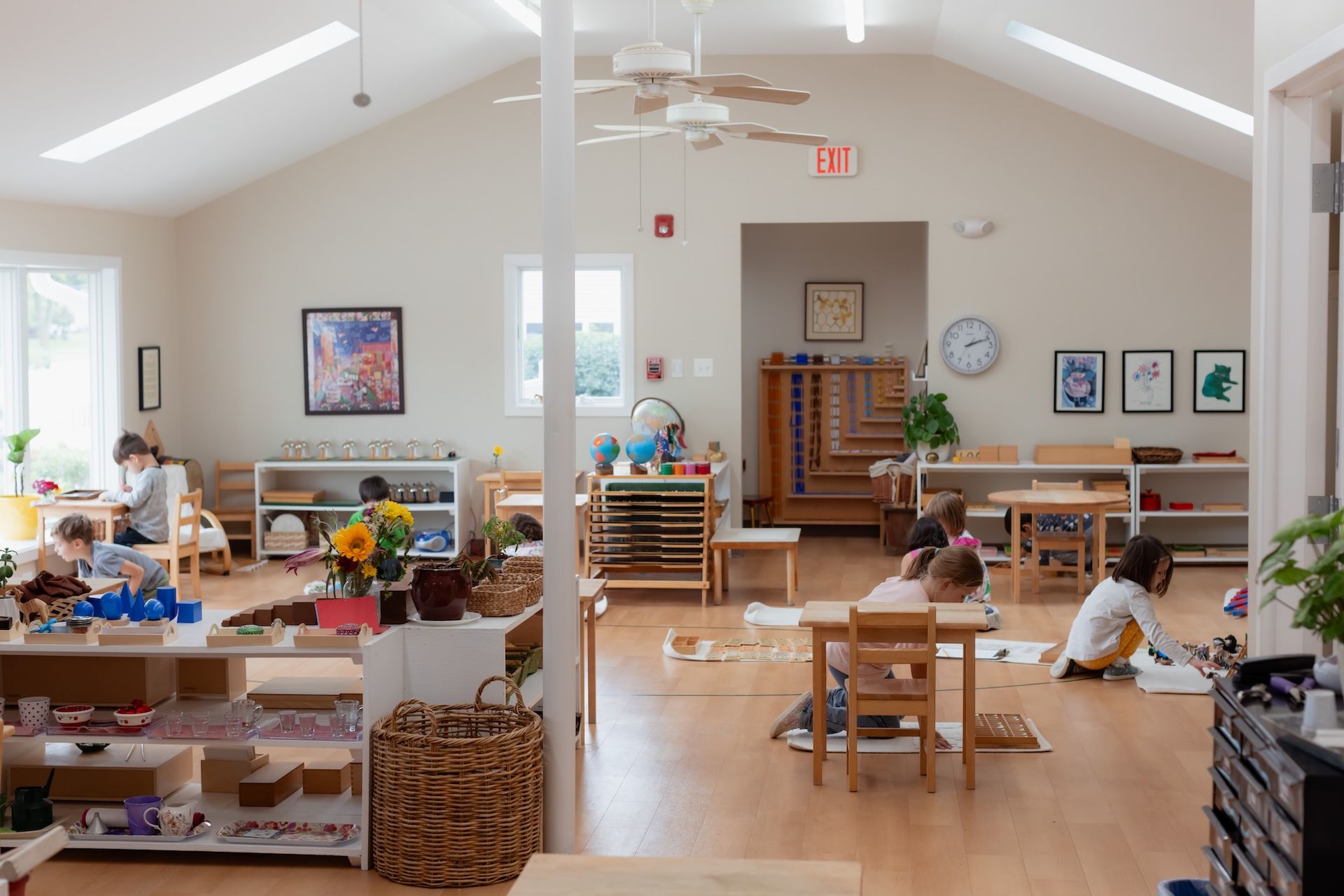
Children in a Montessori classroom construct themselves through experiences in the environment, as Piaget described; through interactions with others, as Vygotsky proposed; and through their own culturally relevant development, as outlined by Erikson. What the work of these three thinkers ultimately demonstrates is that Dr. Montessori (working largely through direct observation of children, decades before most of these theoretical frameworks existed) was right.
What This Means for Families
It would be interesting to explore the extent of Montessori's influence on theorists such as Piaget, Erikson, and Vygotsky. What is clear is that Montessori set the stage for practitioners to understand the importance of a prepared environment: a place where children can fulfill human tendencies, take advantage of sensitive periods, and feel at home as they develop their inner and outer selves.
Understanding these convergences helps us see how Montessori education is not a niche philosophy or a passing trend. It is grounded in careful observation and rigorous developmental science spanning over a century and crossing cultural and disciplinary boundaries.
Children in a Montessori classroom are supported not just by one person's vision, but by principles that some of the greatest minds in child development have independently confirmed.
We'd love to talk more about the developmental philosophy behind our program.
Visit us in New York and see it in action.