
Less Is More: The Four Things Montessori Teachers Work Hard to Not Do
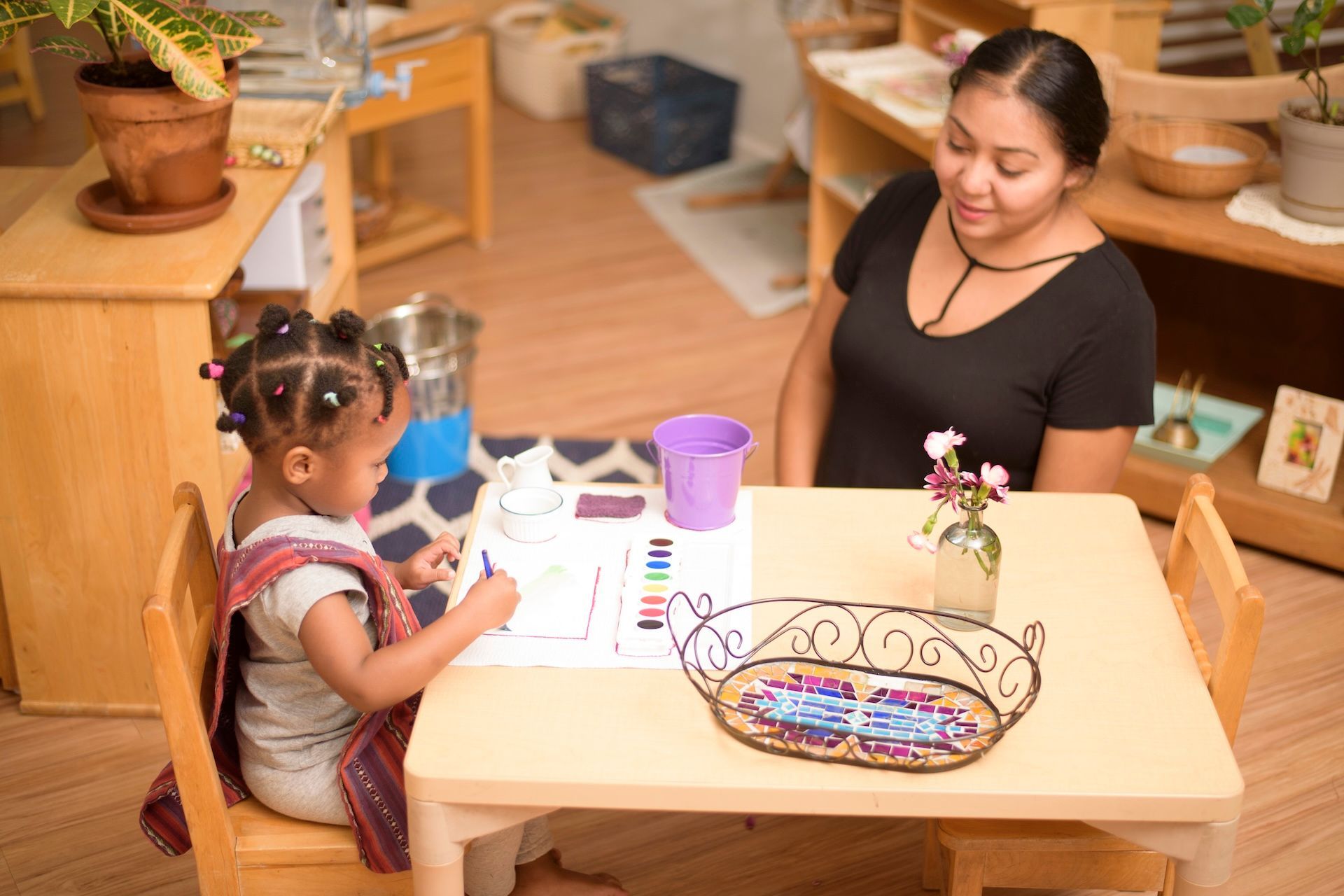
If you come to observe a Montessori classroom, you may notice that the teacher is not the center of attention. You’ll see children moving around, working on various tasks, solving problems, and helping each other, while the teacher moves quietly through the room, watching, waiting, stepping in briefly.
This is a careful, deliberate practice (and, for what it’s worth, it may be the hardest thing a Montessori teacher learns to do!).
Dr. Montessori described the ideal teacher this way: "She moves about slowly and silently. She goes up to one who has called her. Her supervision is such that anyone who needs her is immediately aware of her presence, whereas those who do not are completely oblivious of her."
To inhabit that role authentically, a Montessori teacher consciously works to avoid four practices that, however well-intentioned, ultimately hinder rather than help children's development. Those four practices are: interfering, domineering, admonishing, and serving.
The First Practice to Avoid: Interfering
Of all the habits we bring into the classroom, our impulse to interfere may be the most deeply ingrained. When children struggle, our instinct is to step in, offer the solution, and smooth the path. It takes genuine discipline to recognize that the struggle itself is often where the learning happens.
Dr. Montessori illustrated this with a simple, striking example. A teacher was about to interrupt a child who was coloring a tree trunk red, ready to ask whether the child really thought trees had red trunks. Dr. Montessori stopped her and let the child color the tree red. The child was not making a mistake to be corrected. Instead, the child was on a discovery process that adults could honor.
Children find their own solutions. They come to agreements among themselves that adults would never anticipate. When we step in to resolve what looks like a problem, we often disturb a harmony that the children were perfectly capable of finding on their own. We rob the children of the deep satisfaction that comes from figuring it out.
As Dr. Montessori observed, children who are left to manage their own challenges often "feel irritated if we intervene, and find a way if left to themselves." The teacher's role is not to prevent the problem, but to observe, to trust, and to be genuinely available only when something is beyond the child's current reach.
This requires, as Dr. Montessori acknowledged, a fundamental shift in how we as adults understand our role. We might intellectually grasp the idea, but it is genuinely difficult to embody: "This idea, that life acts of itself, and that in order to study it, to divine its secrets or to direct its activity, it is necessary to observe it and to understand it without intervening — this idea is very difficult for anyone to assimilate and to put into practice."
The Second Practice to Avoid: Domineering
Closely related to interference is domination, which is the practice of imposing our adult will, schedule, or expectations upon children’s natural developmental. In traditional educational settings, the entire structure of the day is built on a domineering framework: children are told when to start, when to stop, when to move, when to be still, what to work on, and how long to spend on it. This assembly-line structure not only interrupts concentration, it also repeatedly and implicitly communicates that children's own inner guidance cannot be trusted.
In Montessori, we take the opposite position. Our goal is not external compliance but inner discipline. This self-regulation grows from the inside out, nurtured by freedom within clear and respectful limits. As Dr. Montessori wrote with characteristic directness, "The basic error is to suppose that a person's will must necessarily be broken before it can obey." Forcing obedience does not build discipline. It builds dependence on the adult's direction to know what to do next, and on external pressure to do it.
Dr. Montessori offered an image of imposed silence and stillness as "annihilation" rather than discipline: "We do not consider an individual disciplined only when he has been rendered as artificially silent as a mute and as immovable as a paralytic. He is an individual annihilated, not disciplined." True discipline, the kind that serves children throughout life, is built through purposeful, self-directed work, not through the suppression of spontaneous activity.
The Third Practice to Avoid: Admonishing
Admonishing (the habit of correcting, scolding, and constantly drawing attention to mistakes and shortcomings) is perhaps the most common obstacle to children's inner development and, in many ways, the most counterproductive.
A useful image for thinking about this is the distinction between watering flowers and watering weeds. When adults focus their attention and energy on what children are doing wrong (marking errors, issuing reprimands, pointing out failures), we are, in effect, watering the weeds. Children’s confidence decreases. Their energy drains. Their relationship with learning becomes fraught with the anxiety of being judged.
As Dr. Montessori wrote, "To tell a child he is naughty or stupid just humiliates him; it offends and insults, but does not improve him. For if a child is to stop making mistakes, he must become more skilled, and how can he do this if, being already below standard, he is also discouraged?"
So we redirect attention from the mistake to purposeful activity. This requires that we provide an environment rich enough with interesting, meaningful work that children are naturally drawn toward growth and competence. In this sense, we don’t invoke discipline through reprimand. As Dr. Montessori explained, "The end is obtained not by attacking the mistake and fighting it, but by developing activity in spontaneous work."
What tends to emerge in this kind of environment? Children begin to admire each other's accomplishments rather than compete with them. "They admire those who do better than they do," observed Dr. Montessori. When the adult is not constantly measuring and comparing, children are freed from the need to measure and compare themselves.
The Fourth Practice to Avoid: Serving
The fourth practice (and perhaps the most surprising on this list) is serving children. Not in the sense of care and warmth, which are always appropriate, but in the sense of doing for children what they are capable of doing for themselves.
Dr. Montessori described a scene that captures this. A child was stretching and straining to see something of interest, working hard to figure out a solution. A teacher lifted the child. Problem solved, from the adult's perspective. But what had actually happened? The child's expression of "anxiety, hope, and joy,” which is the look of a person engaged in genuine effort, "was replaced by the stupid expression of a child who knows that others will act for him."
That moment of being lifted did not help the child. It taught the child that their own efforts weren’t enough and that an adult would step in. Repeated across hundreds of daily interactions, this is how capable children learn to feel incapable.
"We habitually serve children," wrote Dr. Montessori, "and this is not only an act of servility toward them, but it is dangerous, since it tends to suffocate their useful, spontaneous activity." The child who is dressed, fed, carried, and managed at every turn is denied the most important work of early childhood: building a sense of genuine competence through real effort.
This doesn't mean adults disappear. It means we calibrate our support precisely. It means we are present and available, but restrained enough to let children reach, try, struggle, and ultimately succeed on their own terms.
The Ongoing Work
Avoiding these four practices — interference, domination, admonishment, and over-serving — is genuinely difficult! These tendencies are deeply human and originate from care, good intentions, and deeply ingrained habits of how to relate to children. Dr. Montessori herself acknowledged the challenge: "Nothing is more difficult for a teacher than to give up her old habits and prejudices."
But this is precisely why the Montessori teacher's role is not passive, even when it looks that way from the outside. It requires tremendous awareness, ongoing self-reflection, and a deep faith in children's capacity to grow when given the space to do so.
And what happens when that space is genuinely protected, when we step back, trust children, and resist the well-meaning impulses to interfere, dominate, admonish, and serve? We get to see the emergence of children who know how to guide themselves, delight in their own competence, and carry an inner confidence that no gold star or correction could ever produce.
We'd love for you to
observe our classroom in New York and see this approach in action. Schedule a visit and see what children can do when adults learn to get out of the way!