
Beyond Beauty: The Purposeful Science of Color-Coding in the Montessori Classroom
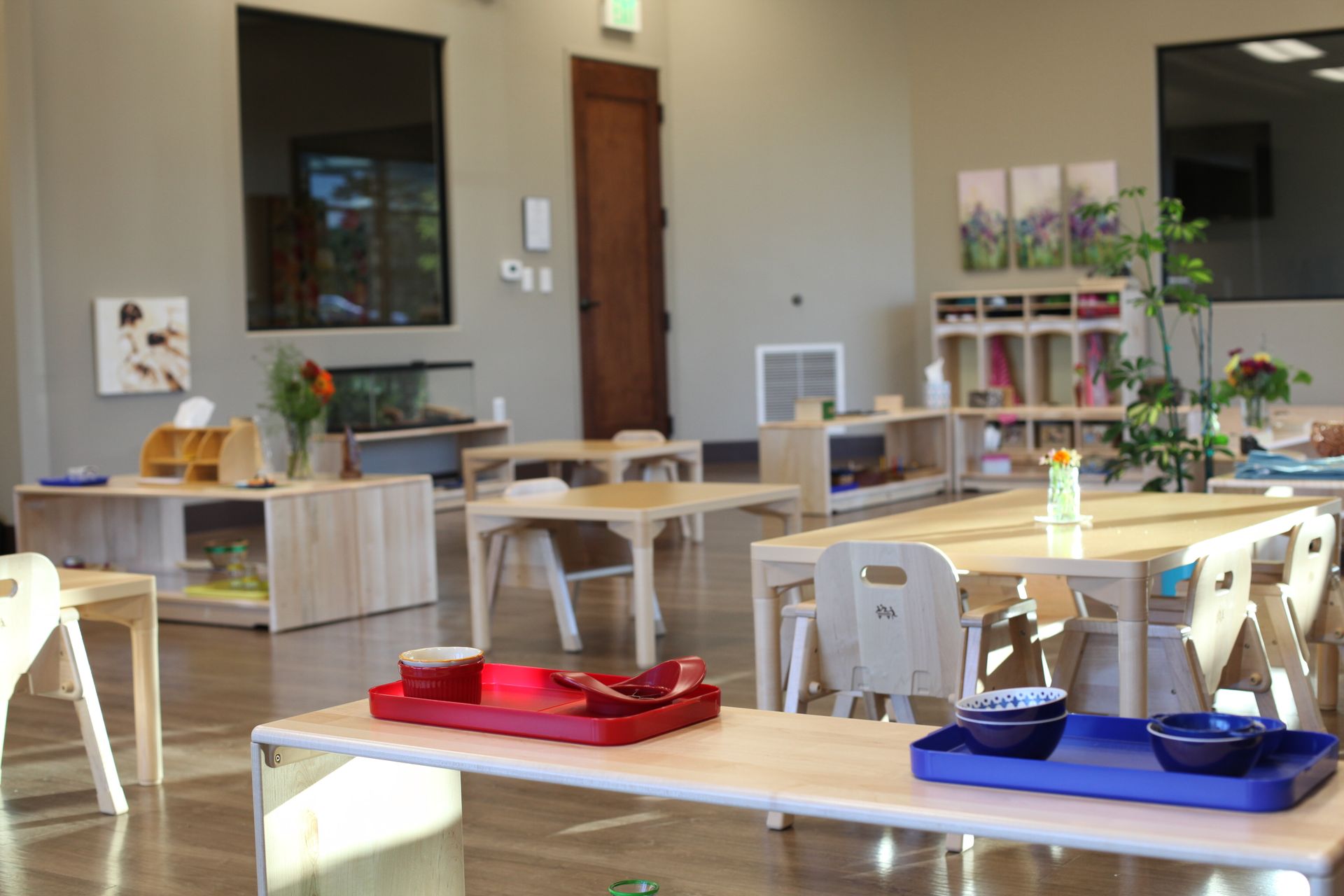
When walking into a Twin Parks Montessori classroom across our Central Park, Park West, or Riverside campuses, families immediately notice the warm, attractive quality of the environment. As you scan the natural wood shelving, the vibrant, colorful materials stand out in intentional contrast to the calm, neutral backdrop of the room.
These materials are designed to be visually appealing so young children are naturally drawn to them. However, beauty is only the beginning. Every color choice in a Montessori classroom serves a precise neurological purpose: organizing the environment, supporting executive function, and accelerating cognitive development.
Creating External and Internal Order
In our Toddler and Early Childhood classrooms, Practical Life activities—such as table washing, window cleaning, plant care, or flower arranging—are organized so that all tools for a specific task match by color. A child washing a table will find a color-matched tray, apron, bucket, and drying cloth. These color cues allow even our youngest toddlers to independently select, complete, and return an entire activity without relying on adult direction.
Sensorial materials also isolate specific qualities using color. When exploring dimensions with the Pink Tower, every cube is the exact same shade of pink, ensuring the child's mind isolates the concept of size without being distracted by varying hues. Similarly, matching pairs in the Sound Cylinders share subtle color indicators to support self-correction.
This visual organization helps children make sense of their physical environment while simultaneously constructing an internal sense of mental order.
Color Integration Across Subject Areas
As children move from foundational sensorial work into language, mathematics, and geography, color-coding becomes a sophisticated scaffold for complex academic concepts:
- Geography: When Early Childhood students explore the Montessori Puzzle Maps and Globes, every continent retains a consistent, universal color. North America is always orange, South America is pink, Europe is red, Asia is yellow, Africa is green, Australia/Oceania is brown, and Antarctica is white. All extension materials—from continent picture packets to cultural research folders—maintain this exact color scheme across all three of our campuses.
- Mathematics & Bead Cabinet: Children learn to associate specific quantities with both the number of beads and their designated color. A ten-bar is composed of ten gold beads; nine is dark blue; eight is brown; seven is white; six is light purple; five is light blue; four is yellow; three is pink; two is green; and one is red. This color coding remains identical throughout advanced math work, from basic addition in Early Childhood to squaring and cubing.
- Grammar & Parts of Speech: Language materials assign distinct colors and geometric shapes to parts of speech—such as solid black triangles for nouns and vibrant red circles for verbs—making sentence analysis a tactile, visual experience.
Strengthening Neural Pathways and Memory
Modern neuroscience confirms what Dr. Maria Montessori observed over a century ago: how the brain processes color deeply impacts attention, comprehension, and long-term retention. Color activates neural connections and integrates sensory input, allowing young learners to build consolidated meaning.
When an Early Childhood student counts six light-purple beads on a bar, their brain creates a direct neural pathway. Over time, simply seeing the light-purple bar instantly evokes the concept of "six" without needing to count each individual bead. When children later encounter compound multiplication or fractions, these established neural pathways provide a familiar, concrete anchor.
Bridging Concrete Learning to Abstract Thought
Color-coding helps children transition smoothly from concrete objects to abstract mathematical and linguistic thinking.
In place value work, decimal hierarchies are color-coded: units are green, tens are blue, and hundreds are red. Because thousands are also green (unit thousands), ten thousands are blue, and hundred thousands are red, children quickly grasp the recurring pattern within the decimal system. When moving from physical bead bars to tile-based stamp games, a small blue tile stamped "10" instantly communicates its true value because of the established color association.
Experience Purposeful Design at Twin Parks
Every detail in a Twin Parks Montessori classroom—from the shade of a bead bar to the organization of a water-pouring tray—is prepared with deep purpose. By combining beauty with scientific intention, we empower children to move from hands-on exploration to confident, abstract thinking.
We invite you to see our prepared environments in action. Schedule a
campus tour at Central Park, Park West, or Riverside Montessori to watch how our guides bring learning to light.