From Metal Insets to Meaningful Stories: How Twin Parks Nurtures Handwriting, Literacy, and Fine Motor Skills
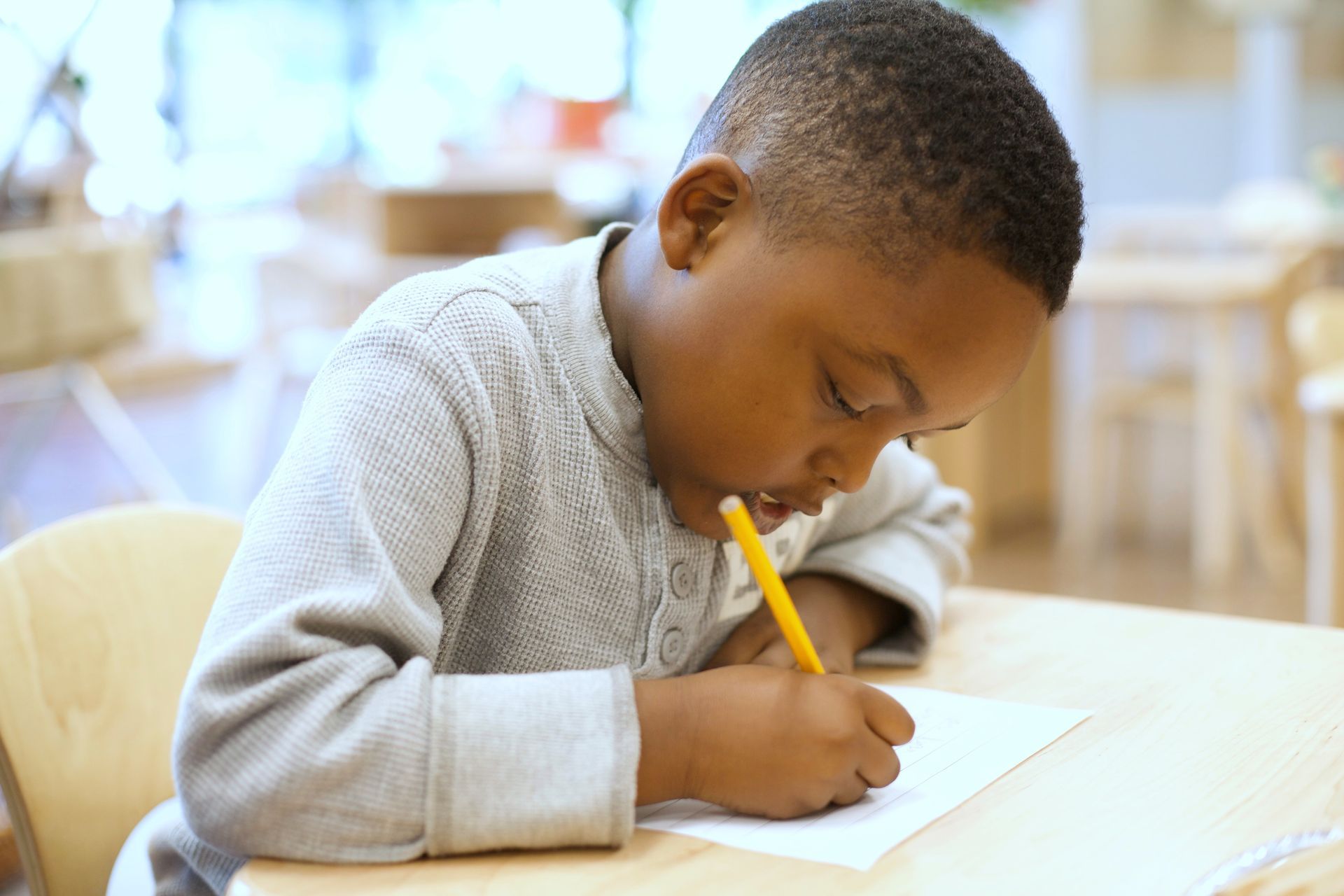
Handwriting, penmanship, or letter formation—whatever you call it—was likely a foundational part of your own early education. In recent years, pressed by standardized time constraints and screen-heavy curricula, many traditional schools have moved away from explicit handwriting instruction. This shift has resulted in a generation of children who often struggle with fluid pencil control and legible letter formation.
Scientific research continues to confirm what Dr. Maria Montessori observed over a century ago: handwriting is deeply connected to brain development and literacy. Studies show that handwriting—as opposed to typing or tracing on a screen—directly guides preliterate children toward developing reading skills. Engaging in direct handwriting instruction aids neural processing, enhances letter recognition, and improves long-term spelling and composition skills. When children master the physical mechanics of letter formation early on, their minds are freed to focus on creative expression, vocabulary, and story construction rather than struggling with how to form a "q."
The Montessori Difference: Indirect Preparation and the Pincer Grasp
At Twin Parks Montessori School across our Central Park, Park West, and Riverside campuses, handwriting is a critical, organic component of the curriculum. Rather than drilling letter formation on worksheets, our approach relies on indirect preparation that begins in our Toddler and Early Childhood classrooms long before a child ever holds a pencil.
Very young children naturally develop the hand strength, finger dexterity, and wrist flexibility needed for a proper pincer grasp through daily Practical Life and Sensorial work. Everyday materials—like the Knobbed Cylinders, small water pitchers, and tongs—refine muscle control in the exact fingers used for holding a pencil.
Key Early Childhood Materials for Handwriting Readiness
In our Early Childhood (ages 3–6) classrooms, two foundational Montessori materials bridges the gap between hand strength and fluid writing:
- The Metal Insets: This work consists of ten metal frames holding geometric shapes with small knobs. Children trace the metal shapes onto paper with colored pencils and fill the shapes with controlled, parallel lines. While it looks like a joyful design exercise, its main purpose is to build pencil control, lightness of touch, and continuous muscle movement without fatiguing the hand.
- The Sandpaper Letters: Beautiful wooden tiles feature smooth, tactile sandpaper letters. Guides teach children to trace the textured letter with two fingers while pronouncing its phonetic sound (focusing on sounds first rather than letter names directly supports early reading). This multi-sensory connection—combining sight, sound, and touch—carves strong neural pathways for letter recognition.
The Magic of Writing Before Reading
Because our prepared environments separate the physical skill of holding a pencil from the intellectual task of composing words, many Montessori children naturally begin writing before they are fluently reading. Using the Movable Alphabet, a child can compose phonetic words and express complex thoughts long before their hand is ready to write them all down. Once hand control and phonetic awareness merge, writing becomes a joyful, self-directed form of expression.
As children progress through their final year in Early Childhood and prepare for ongoing schools, handwriting becomes a daily tool across all subject areas. Whether recording observations about plant lifecycles, copying poetry, or illustrating research, our students write with purpose, confidence, and pride.
Experience Handwriting in Action at Twin Parks
The best way to appreciate the intentional design of our classrooms is to see it firsthand. We invite current and prospective families to
observe our prepared environments and watch how natural, joyous, and foundational early handwriting work truly is.