From Sandpaper Globes to Global Citizens: How Montessori Geography Helps Young Children Understand Their World
Between books, family travel, and everyday conversations in a city as culturally vibrant as New York, young children hear a lot of abstract language about our planet. They hear phrases like “going around the world,” “flying across the ocean,” or “visiting the other side of the Earth.”
While young children absorb these concepts eagerly, the early childhood mind requires concrete, hands-on experiences to make genuine sense of what “the world” actually means.
Over a century ago, Dr. Maria Montessori observed how deeply drawn young children were to geography materials. Through careful observation, she realized that children crave a tangible, sensorial understanding of the Earth before they can grasp abstract geographical concepts.
At Twin Parks Montessori School—across our Central Park, Park West, and Riverside campuses—geography in our Early Childhood classrooms is not taught through memorization or lectures. Instead, it is an active, sensory-driven journey of discovery.
Concrete Materials for Concrete Learners
To help young children form an accurate mental picture of the planet, the Montessori geography curriculum begins with touch, sight, and purposeful activity.
1. The Sandpaper Globe
We introduce geography with a small, specialized globe. The land masses are covered in rough sandpaper, while the oceans are smooth, painted blue surfaces. By running their hands over the sphere, children physically feel the distinction between land and water. They gain a concrete understanding of the Earth’s shape and a clear, tactile context for what it means to travel “around the world.”
2. Land and Water Forms
To explore how land and water interact, children work with three-dimensional landform models. Children carefully pour water into trays representing islands, lakes, peninsulas, gulfs, isthmuses, and straits. As the water flows around the raised landforms, children observe the geographical relationships directly. This hands-on work is paired with photo folders showing real-world examples of these features from across the globe.
3. The Colored Continent Globe
Next, children transition to the continent globe. On this globe, the water remains smooth blue, but each continent is painted a distinct, consistent color—green for Africa, red for Europe, orange for North America, pink for South America, brown for Oceania, yellow for Asia, and white for Antarctica. This color-coding remains identical across all Montessori geography materials, strengthening visual recognition and memory.
4. Hemisphere and Continent Puzzle Maps
Once a child grasps the layout of the globe, we introduce the flat wooden puzzle maps. The World Continent Map presents the Eastern and Western Hemispheres side by side, allowing children to see all seven continents at once. Children remove and replace each continent piece using small wooden knobs located at key geographical points.
As children master the world map, they move on to individual continent maps divided into national boundaries. Each country is an individual puzzle piece, with the knob placed precisely at its capital city. Children initially explore these maps sensorially, tracing the edges of the pieces. Over time, they effortlessly absorb the names of continents, countries, and capitals. Older children even love the challenge of closing their eyes, tracing a puzzle piece by touch alone, and identifying the country!
Cultivating Appreciation, Empathy, and Community
While the geographical knowledge children gain is impressive, turning children into walking encyclopedias is never our main objective.
In the Montessori philosophy, geography is the foundation for cultural appreciation, peace education, and global citizenship. Our goal is to help children understand their place in the world, appreciate the shared needs of all human beings, and celebrate the rich diversity of cultures across the globe.
To support this exploration, our classrooms feature curated image collections and cultural artifacts organized by continent. Children examine photographs showcasing daily life around the world—exploring how different cultures approach food, shelter, clothing, transportation, music, and family traditions.
Children see that while people adapt differently to their local environments, our fundamental human needs remain the same. This work connects deeply with our daily outdoor exploration, where children observe local ecosystems and develop a personal reverence for the natural world.
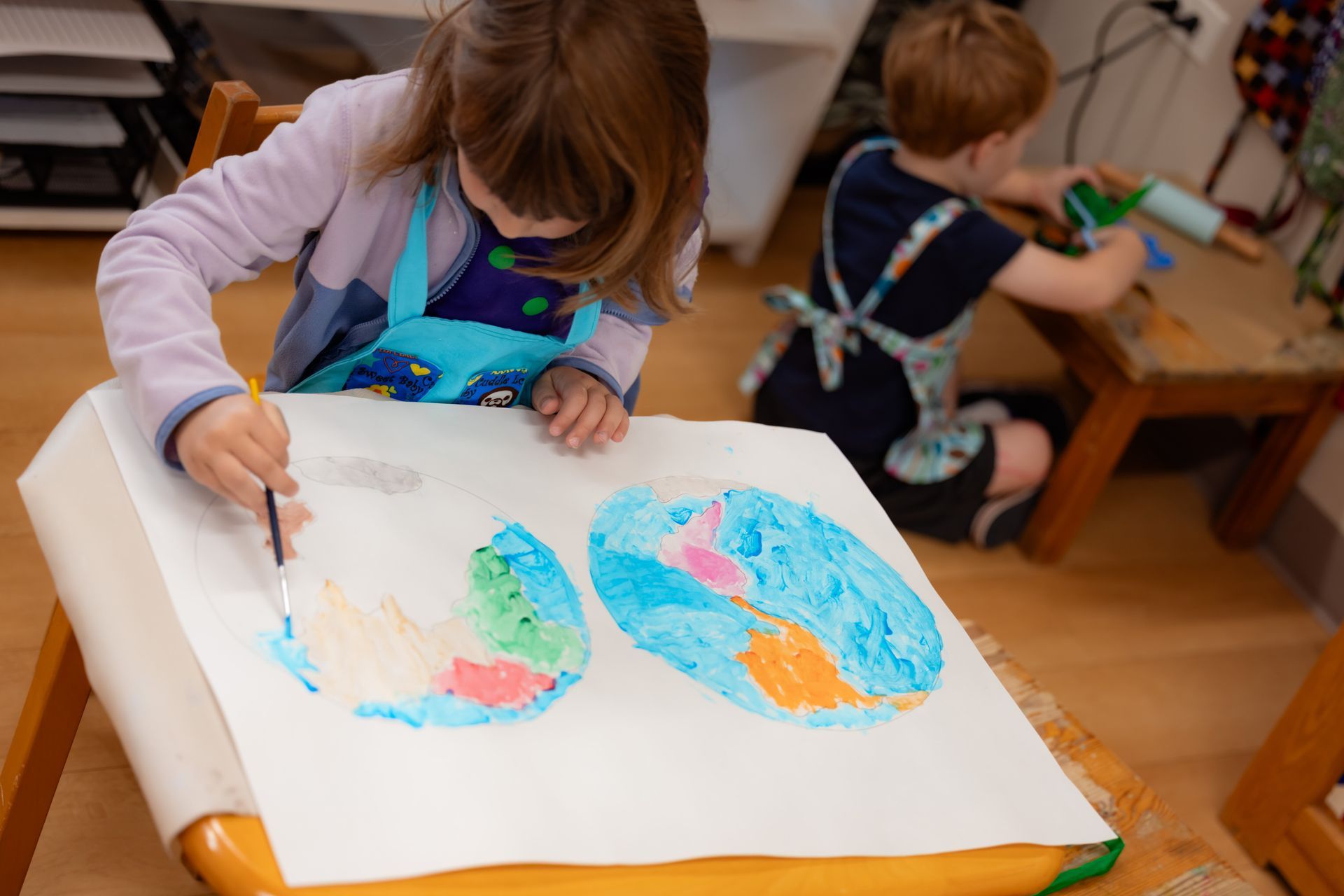
As their interest grows, children often begin creating their own maps—carefully tracing puzzle pieces, coloring continents, labeling countries, and researching the plants, animals, and climates of different regions.
Experiencing Geography in Action
At Twin Parks Montessori School, geography gives children far more than academic vocabulary. It nurtures a constructive, joyful relationship with the planet and instills a deep respect for the diverse global community we share.
We invite Upper West Side families to
schedule an information session to learn more about our Montessori schools.