More Than Words: The Montessori Approach to Language in the First Three Years
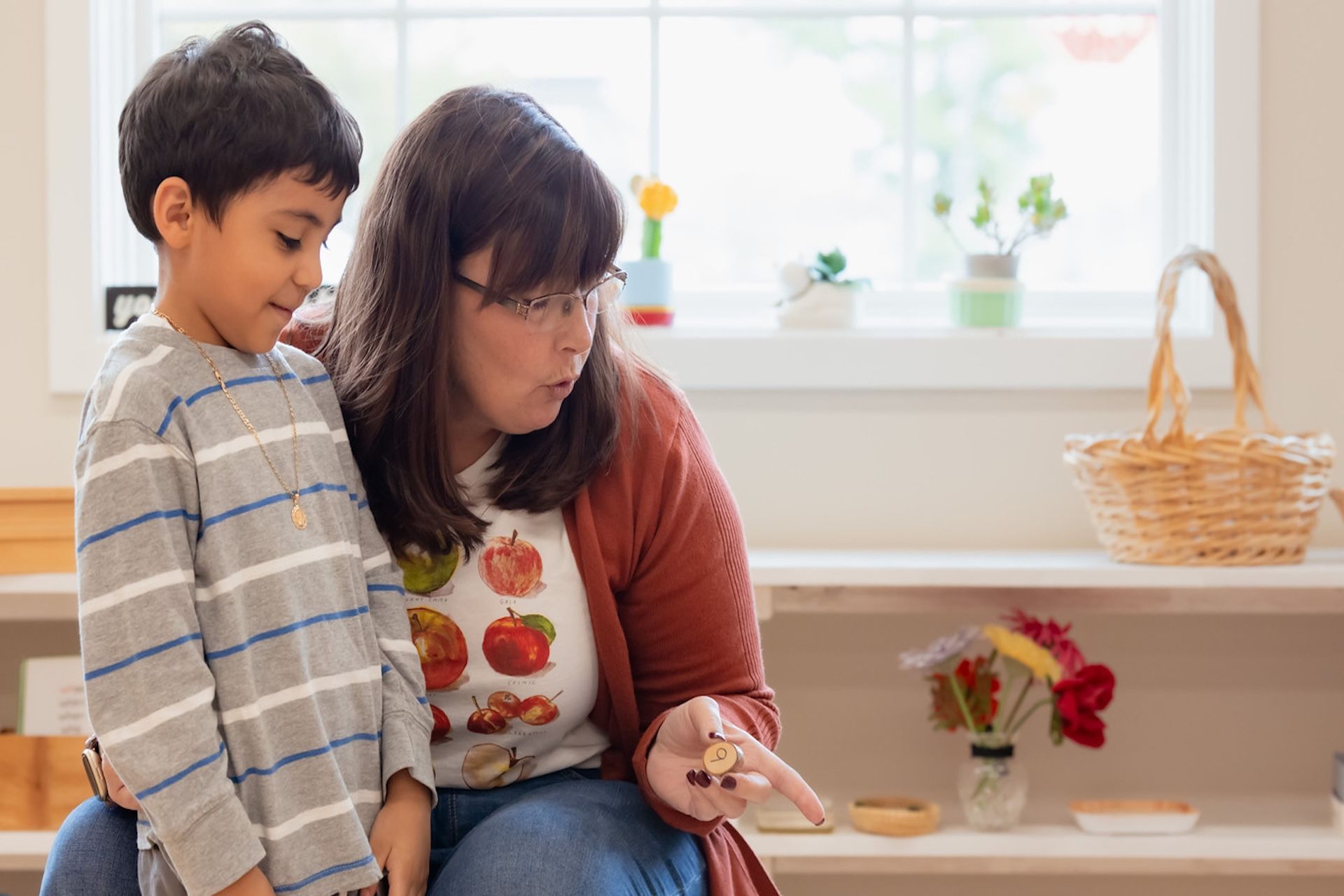
We all know that our little ones’ language doesn’t begin with their first word. Language begins at birth (even prenatally) through touch, movement, sound, eye contact, and relationship.
For children ages zero to three, language development is deeply intertwined with every aspect of daily life. It is not confined to a “lesson,” but lives in caregiving routines, shared moments, and the prepared environment itself.
More Than Words
In Montessori, we think about how language development has three essential components:
- Every verbal interaction throughout the day
- The materials we prepare for children
- The non-verbal communication of the adult
When we name objects during diapering, narrate a nature walk, sing during a transition, or pause to acknowledge a child’s feelings, we are supporting language development. Just as important is our awareness of our own body language: our facial expressions, tone of voice, posture, and pace.
Of course, we also know that children communicate long before they use words. Their cries, gestures, movements, and expressions are all part of early language. When adults learn to “listen” to these cues and respond with care, children feel understood and their language development flourishes.
If we think about language learning in the first years of life, and how language is the vehicle through which we connect with one another, we can understand how people themselves are the most important language material for infants and toddlers.
The Role of Language Materials in Montessori
That said, alongside daily interactions, it also helps to offer carefully prepared language materials to help children build a rich, precise vocabulary. In Montessori settings, these materials may include:
- Real objects (nomenclature objects)
- Replicas
- Objects with exact matching cards
- Objects with similar matching cards
- Nomenclature cards
- Books
- Songs and rhythmic language
Later, as children begin to speak more, we can also incorporate more opportunities for self-expression and question-and-answer activities.
We classify all of our language materials by category. For example, objects for the bathroom, items from the beach, or animals that are pets, etc. This classification helps children organize and make sense of the world.
The Progression of Language Materials
We also offer language materials in a thoughtful progression that follows children’s physical, emotional, and intellectual development. There is no rush. Observation guides everything.
Here is a general progression you might see in a Montessori infant or toddler environment:
- Books: Early books for newborns are often black and white with no words, supporting visual focus. Gradually, books include one clear image per page, then simple phrases, and eventually more detailed text and images.
- Songs: We want to introduce songs from birth and make them part of daily routines. Singing supports memory, rhythm, emotional regulation, and connection, and it can be especially useful during transitions.
- Collections of Real Objects: Real objects help children build vocabulary while engaging their senses. A basket of vegetables, for example, offers opportunities to experience weight, texture, smell, and language all at once.
- Replicas: When real objects aren’t possible, we use replicas. We choose these carefully to be as realistic as possible.
- Replicas with Exact-Matching Cards: These materials help children link a three-dimensional object to a two-dimensional image, supporting the gradual move from concrete experience to abstraction.
- Replicas with Similar Cards: Next we offer cards that don’t have an exact image, but rather a similar one. By matching objects to a similar image, children begin to abstract the idea rather than find the exact match.
- Nomenclature Cards: Eventually, children work with images alone, no longer needing the object present. The same cards they once used for matching can serve purely as nomenclature.
The Purpose Behind the Materials
The goal of Montessori language materials is not for a child to correctly label an object. The true purpose is to support the child’s process of self-construction, which includes their growing understanding of the world, their place in it, and their ability to connect with others. Language work is about meaning, relationship, and discovery.
How Language Materials Are Used
To support deep engagement, Montessori environments follow a few key guidelines. When we introduce the materials, we:
- Begin with only a few objects at a time
- Include familiar items to build confidence
- Offer 6 to 8 objects per category
- Start with object nomenclature before adding matching cards
- Rotate materials regularly
- Use baskets and containers that are beautiful and meaningful
- Arrange materials in a logical sequence (objects → matching → cards)
Younger children work primarily with real objects, and all materials are proportionate in size and as realistic as possible.
Most importantly, language materials are never meant to be used alone. Language happens between people. An adult (or sometimes an older child) must be present to give the work meaning.
How Adults Support Language Every Day
Parents and caregivers play a vital role in language development. Some simple but powerful practices include:
- Using language during every interaction
- Reading and singing daily
- Speaking slowly and clearly with eye contact
- Naming body parts, clothing, and objects during care routines
- Responding thoughtfully to early sounds and words
We refrain from correction and instead model accurate language naturally, protecting children’s confidence and joy in communication.
Language as a Foundation for the Whole Child
Through respectful interactions, beautiful materials, and attentive adults, children from birth to age three are given the gift of language as a tool for understanding, expression, and connection.Schedule a tour here in New York to learn more!